×
- Hello
- Login or Register
- Quick Links
- Live Chat
- Track Order
- Parts Availability
- RMA
- Help Center
- Contact Us
- Shop for
- Mazda Parts

My Garage
My Account
Cart
Genuine 1997 Mazda Millenia Axle Shaft
Car Axle Shaft- Select Vehicle by Model
- Select Vehicle by VIN
Select Vehicle by Model
orMake
Model
Year
Select Vehicle by VIN
For the most accurate results, select vehicle by your VIN (Vehicle Identification Number).
2 Axle Shafts found
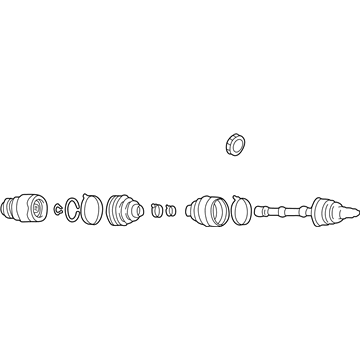
1997 Mazda Millenia Axle Assembly Part Number: GP11-25-60X
Product Specifications- Other Name: Drive Shaft Left
- Position: Driver Side
- Item Weight: 16.60 Pounds
- Condition: New
- Fitment Type: Direct Replacement
- SKU: GP11-25-60X
- Warranty: This genuine part is guaranteed by Mazda's factory warranty.
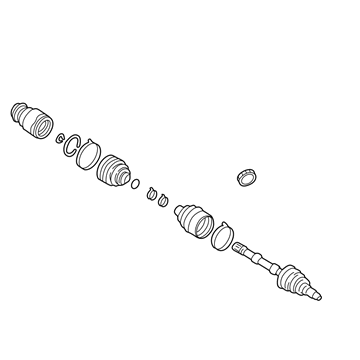
1997 Mazda Millenia Axle Assembly Part Number: GR05-25-60XR-0F
Product Specifications- Other Name: AXLE,REMAN (28 SPLINES)
- Position: Driver Side
- Item Weight: 16.20 Pounds
- Condition: Remanufactured
- Fitment Type: Direct Replacement
- SKU: GR05-25-60XR-0F
- Warranty: This genuine part is guaranteed by Mazda's factory warranty.
1997 Mazda Millenia Axle Shaft Parts and Q&A
- Q: How to remove and install the axle shaft while ensuring proper clutch operation in manual transaxle on 1997 Mazda Millenia?A: Removal and installation of axle shaft require the vehicle to be raised and supported first and then the wheel and tire assemblies to be removed. Empty the transaxle and, where fitted, take off the splash shield. Take a hammer and a chisel and raise the staked part of the hub locknut, lock the hub with the brakes and loosen the nut. Loosen the stabilizer bar connection with the lower control arm, remove the cotter pin and nut on the tie rod end ball stud, using an appropriate tool to loosen the tie rod end connection with the knuckle. In certain models, take out the transverse, remove transverse ball joint pinch bolt, transverse ball joint nut and then apply a pry bar to open the ball joint and the knuckle. In some models that have the automatic transaxle, in order to remove the left side shaft, the engine must be suspended and the engine mount member removed. Use a lot of care when removing the axle shaft out of the transaxle; do not break the oil seal, and, when necessary, the intermediate shaft by removing the support bearing bolts. To install, fit a new circlip on the intermediate shaft, fit it to the transaxle and tighten the support bearing bolts. Insert a new circlip on the axle shaft and insert it into the transaxle and through the hub, loosely folding a new locknut. In certain models, the engine mount member may be installed and the required bolts and nuts may be tightened. Insert the knuckle with the lower ball joint and screw the pinch bolt and nut and re-insert the transverse member where necessary. Screw the tie rod end to the steering knuckle, screw the nut tight, and put a new cotter pin. Install the stabilizer bar, splash shield and wheel tire assemblies once more and lower the vehicle. Lock the hub using the brakes and tighten the new hub nut staking it afterwards. They should fill with the right fluid in the transaxle. In the case of CV-joint overhaul, remove the ball bearings, inner ring, and cage, which are located on the driveshaft, dismantling the clip and snapring, and extracting the ball bearings one by one. Make a match of the cage and inner ring, and rotate the cage and remove it. Reassemble in that order but do not forget to repack bearings with grease. The use of asbestos in the clutch parts should be cautioned upon; to avoid the dusts; use brake cleaning fluid to clean the parts. The reason behind the clutch is to couple and uncouple the engine power at the transaxle to enable the engine to develop torque without load. Transfer of engine power is made possible by the gradual transfer of engine power through the clutch mechanism and consists of a release bearing, fork and cylinder assembly. The correct functionality of the clutch can be identified by the fact that it is possible to hold the engine in place when the clutch is released while the vehicle is idle, and that the change of gears is performed without difficulties when the clutch is not engaged.
Related 1997 Mazda Millenia Parts
 1997 Mazda Millenia Battery Hold Downs
 1997 Mazda Millenia Shock Absorber
 1997 Mazda Millenia Steering Knuckle
 1997 Mazda Millenia Valve Lifter
 1997 Mazda Millenia Wheel Seal