×
- Hello
- Login or Register
- Quick Links
- Live Chat
- Track Order
- Parts Availability
- RMA
- Help Center
- Contact Us
- Shop for
- Mazda Parts

My Garage
My Account
Cart
Genuine Mazda B2000 Fuel Pump
Gas Pump- Select Vehicle by Model
- Select Vehicle by VIN
Select Vehicle by Model
orMake
Model
Year
Select Vehicle by VIN
For the most accurate results, select vehicle by your VIN (Vehicle Identification Number).
3 Fuel Pumps found

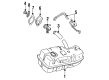
Mazda B2000 Fuel Pump Part Number: AM16-13-ZE0
$263.36 MSRP: $351.22You Save: $87.86 (26%)Ships in 1-2 Business Days
Mazda B2000 Fuel Pump Part Number: FE85-13-350A
Mazda B2000 Fuel Pump Part Number: AM17-13-ZE0
Mazda B2000 Fuel Pump
The Mazda B2000 Fuel Pump is the lifeline of the truck, forcing the gasoline in the tank to the carburetor or, in later injection models, to the fuel rail at the pressure required to achieve clean combustion. Early versions had a camshaft-driven mechanical Fuel Pump bolted to the engine block, whose lever is guided by an eccentric, sucking fuel at approximately 6 to 15 psi and holding it in the carburetor float bowl with a float valve. Having switched the platform to the use of fuel injection, Mazda installed an electric Fuel Pump in the tank, where it is submersion-cooled to allow pressures of 40 psi or more. The purpose of the two types of pumps is similar, shedding pounds of volume, but they differ in location, operating pressure, and power supply, so it is essential to know what system your specific B2000 model has. To isolate faults, the electric motor can be audible near the filler neck, where the driver can listen, or voltage checks can be performed at the connector on mechanical systems when the engine will not start. Gallons per hour or liters per hour of performance assist in calculating the required flow, which is multiplied by 0.5 and divided by 6.2 to obtain the minimum capacity. Mazda guidelines state that a regulator might be required in high-flowing mechanical units to reduce pressure, and electronically controlled in-tank designs would shut off in case of a crash to protect safety. Owners of Mazda thereby get the optimal of both worlds in terms of ease and reliability in the delivery of fuel that makes daily commuting a breeze.
Looking for Fuel Pump with proven quality? Choose OEM Fuel Pump. Mazda designs and builds them to strict factory specs. Every piece goes through rigorous quality checks. You'll get parts that fit right and work like new. Shop our huge inventory of OEM Mazda B2000 parts. Enjoy the highly competitive prices online. Our site is your one-stop shop. Each genuine B2000 part includes a manufacturer's warranty. Buy with confidence. Our return policy is simple and hassle-free. In a rush? Choose expedited delivery at checkout. You'll love the streamlined experience from search to checkout to receiving your order.
Mazda B2000 Fuel Pump Parts and Q&A
- Q:How to release the fuel system pressure and test the fuel pump in Gasoline engine on Mazda B2000?A:Deactivate the fuel system pressure, being careful not to smoke or have any source of ignition because the gasoline vapours are volatile. Unplug and disconnect the fuel supply hose of the engine fuel line assembly, and then one puts fuel system testers between the fuel hose and the fuel line assembly. Unplug the harness connector of the Auto Shutdown Relay and connect 12 volts to the terminal marked number 3 to turn on the fuel pump and pressurize the system. When the gauge displays 330 Kpa +/-14 Kpa (48 psi +/-2 psi), the pressure is correct, otherwise, record the pressure and resume testing. Disconnect jumper wire and insert the tester in the fuel line between the Fuel Tank and the fuel filter. In case the pressure is lower than specification, repeat the 12 volts, and in case the pressure rises by 5 psi or above, change the fuel filter. In the case of no change, squeeze the return hose to verify whether there is an increase in the pressure and this will mean that the pressure regulator needs to be replaced though in the case of no change the problem could be a plugged pump filter sock or failed fuel pump. In case of pressure exceeding specification, disconnect the fuel return line hose on the chassis line at the fuel tank and connect a 3-foot length of fuel hose to a gasoline container to hold return fuel which will then undergo another pressure check. Should the pressure at this time be right, remove the kinking of the in-tank return hose and replace the fuel pump assembly in case the in-tank reservoir check valve or aspirator jet is blocked. In case of high pressure, unscrew the fuel return hose off the fuel return line and then attach a suitable hose in place of the fuel return line and insert the other end to a container to redo the pressure test, in case pressure is again high then check the fuel return line whether it is restricted or not, or replace the fuel pressure regulator otherwise it does not indicate any changes. To change the fuel pump, take out the fuel tank out of the car, remove the lock ring by ensuring that it is not tapped clockwise with a screwdriver and then ensure the assembly of the fuel pump comes out. Loosen the fuel pump in the tank to reveal the connection of the return line hose, break the connection of the fuel fitting and take the pump assembly together with the o-ring seal off. Installation requires cleaning the pump seal area of the tank followed by a new o-ring seal, install a new inlet seal and filter to the suction tube, attach the reservoir hose and press together the fittings until they fit. Fit the fuel pump in the tank, screw the locking ring clockwise and finally install the fuel tank back in the car.
- Q:How to test, remove, and install Mechanical fuel pumps on Mazda B2000?A:Additionally, all models of the year 1986 are equipped with a mechanically driven fuel pump on the left-hand side of the cylinder head which is driven by the camshaft. In the case of the 2,184cc 2,184cc 2000 1987-88 car with manual transmission, the fuel pump is placed more on the right side of the cylinder head and is also cam driven. In order to perform a pressure test, initially disconnect the pump-to-Carburetor hose at the carburetor and one connects pressure gauge. Then unhook the fuel return hose off the pump and insert the pump return and the return port on the carburetor. Turn the engine on and idle with gauging the pressure that must not be below 3.9 to 4.4 psi; in case it is not within the required range, the pump is to be changed. To remove and install, disconnect outlet, inlet and return hose at the pump. Next, dismount and take off the pump and the insulator, which throws away the gaskets. The installation is in the inverted sequence of the removal, with the allowance of new gaskets covered with sealer.
Related Mazda B2000 Parts
 Mazda B2000 Carburetor
 Mazda B2000 Air Duct
 Mazda B2000 Air Filter
 Mazda B2000 Carburetor Mounting Gasket
 Mazda B2000 Fuel Filler Hose
 Mazda B2000 Fuel Hose
 Mazda B2000 Fuel Pump Gasket
 Mazda B2000 Fuel Tank
 Mazda B2000 Gas Cap
 Mazda B2000 Intake Manifold Gasket