×
- Hello
- Login or Register
- Quick Links
- Live Chat
- Track Order
- Parts Availability
- RMA
- Help Center
- Contact Us
- Shop for
- Mazda Parts

My Garage
My Account
Cart
Genuine Mazda 323 EGR Valve
Emissions EGR Valve- Select Vehicle by Model
- Select Vehicle by VIN
Select Vehicle by Model
orMake
Model
Year
Select Vehicle by VIN
For the most accurate results, select vehicle by your VIN (Vehicle Identification Number).
6 EGR Valves found
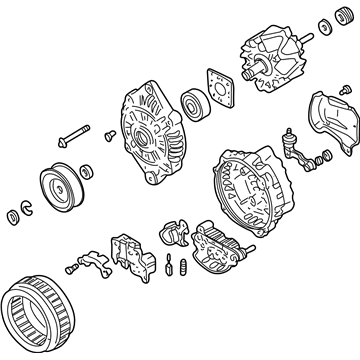
Mazda 323 Alternator Part Number: B6BF-20-300-9U
$294.76 MSRP: $393.09You Save: $98.33 (26%)Ships in 1-2 Business Days
Mazda 323 Solenoid Valve Part Number: BP01-18-740A
$103.76 MSRP: $138.38You Save: $34.62 (26%)Ships in 1-2 Business Days
Mazda 323 Valve Part Number: FE65-18-741A
$96.83 MSRP: $129.12You Save: $32.29 (26%)Ships in 1-2 Business Days
Mazda 323 Three Way Valve Part Number: FE70-18-741A
$100.44 MSRP: $133.95You Save: $33.51 (26%)Ships in 1-2 Business DaysMazda 323 Valve Part Number: BP51-18-741A
Mazda 323 EGR Valve Part Number: B604-20-300-9U
Mazda 323 EGR Valve
The EGR Valve on a Mazda 323 is responsible for helping to keep nitrogen oxides down by regulating the exhaust gas recirculation to lower the temperature levels in the combustion chamber. The Mazda EGR Valve is installed inside a passage that connects the exhaust manifold to the intake manifold. Therefore, it only opens under operating conditions. A metered portion of inert exhaust gas enters the incoming air fuel mixture. This process reduces peak heat which forms NOx and helps in preventing engine knock. A valve in the housing is operated by either a vacuum-controlled diaphragm or by an integrated electric motor, which enables the engine control system to vary the flow as a function of load, speed, and temperature. There are ported vacuum designs that pull from the manifold vacuum, positive or negative backpressure designs that change lift with exhaust pressure, electronically controlled pulse-width modulated ones with a control solenoid, and electronic digital or linear types which feed position back to the computer. No matter how it is activated, the EGR Valve is closed during cold starting, at idle, and at wide-open throttle because exhaust dilution during these conditions would disrupt combustion stability. When the conditions are right, opening the passage will introduce inert gas as part of the oxygen intake air, thereby absorbing heat and decreasing the likelihood of bonding of nitrogen and oxygen at around 2500°F and above. The correct operation of a Mazda 323 will help it to control its emissions. If not, it could cause rough idle, stalling, hesitation, spark knock, and excessive NOx. This may cause the triggering of diagnostic trouble codes and a check engine light on a 323. Mazda power through the ages.
Looking for EGR Valve with proven quality? Choose OEM EGR Valve. Mazda designs and builds them to strict factory specs. Every piece goes through rigorous quality checks. You'll get parts that fit right and work like new. Shop our huge inventory of OEM Mazda 323 parts. Enjoy the highly competitive prices online. Our site is your one-stop shop. Each genuine 323 part includes a manufacturer's warranty. Buy with confidence. Our return policy is simple and hassle-free. In a rush? Choose expedited delivery at checkout. You'll love the streamlined experience from search to checkout to receiving your order.
Mazda 323 EGR Valve Parts and Q&A
- Q:How can oxides of nitrogen emissions be reduced through the EGA system and EGR Valve on Mazda 323?A:Certain exhaust gases are recirculated through the EGA valve to the inlet manifold to reduce oxides of nitrogen emissions by lowering burning temperature. The EGA system consists of an EGA valve, an EGA modulator, a vacuum switching valve (0JSV), a Powertrain Control Module (PCM), and an EGA gas temperature sensor. If the vehicle is a model year 1996 or older, you should start your vehicle's engine and allow it to idle. Then remove the vacuum hose from the EGA valve and then attach a handheld vacuum pump. The vacuum should hold steady while the engine runs rough. With the engine running poorly, apply vacuum to the EGA valve which should also remain steady. If the vacuum remains steady, and the engine is not running poorly, replace the EGR valve and check again. If the vacuum is constant but the engine is not running poorly, remove the EGR valve, check the valve and intake manifold for blockage, and clean or replace the parts if needed. Disconnect the electrical connector at the EGR valve. Check the resistance between the C and E terminals, C and A, D and B, and D and F. For 1997 and later, these terminals C, D, E, and F are used for the electronic EGA valve controlled by the PCM; resistance should be about 22 ohms on each test. With the EGR valve position sensor connector disconnected, measure the resistance between terminal "A" and terminal "B" at the EGR valve position sensor connector using an ohmmeter. The resistance should be 2.7 K-ohms. If not, replace the EGR valve. Reconnect the connector for the EGR valve position sensor, remove the vacuum hose from the EGR valve, and connect the vacuum pump to the valve. Switch on the ignition and check the connector's terminal B voltage. With no vacuum, it should read about 0.8 volts. Apply 5.0 in-Hg vacuum and read a voltage of about 5.0 volts. Examine the harness and connector between the EGR valve and the PCM terminal if the readings do not match specifications. If they are okay, the EGR valve must be replaced.