×
- Hello
- Login or Register
- Quick Links
- Live Chat
- Track Order
- Parts Availability
- RMA
- Help Center
- Contact Us
- Shop for
- Mazda Parts

My Garage
My Account
Cart
Genuine Mazda MPV Driveshaft
Drive Shaft- Select Vehicle by Model
- Select Vehicle by VIN
Select Vehicle by Model
orMake
Model
Year
Select Vehicle by VIN
For the most accurate results, select vehicle by your VIN (Vehicle Identification Number).
1 Driveshaft found

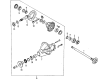
Mazda MPV Drive Shaft Part Number: PAY5-25-010
Mazda MPV Driveshaft
Looking for Driveshaft with proven quality? Choose OEM Driveshaft. Mazda designs and builds them to strict factory specs. Every piece goes through rigorous quality checks. You'll get parts that fit right and work like new. Shop our huge inventory of OEM Mazda MPV parts. Enjoy the highly competitive prices online. Our site is your one-stop shop. Each genuine MPV part includes a manufacturer's warranty. Buy with confidence. Our return policy is simple and hassle-free. In a rush? Choose expedited delivery at checkout. You'll love the streamlined experience from search to checkout to receiving your order.
Mazda MPV Driveshaft Parts and Q&A
- Q: What are the functions and maintenance of driveshafts and universal joints on Mazda MPV?A:The driveshaft is a pipe linking the transfer case or transmission to the rear or front axle and which has Universal Joints (U-joints), each end of which permits the transmission of power at different angles. Every model has a two-piece rear driveshaft (with center bearing support), and 4WD models have a one-piece front driveshaft. All rear driveshafts have their rear parts consist of double-offset (constant velocity) joints directly above the bearer support in the center which allow the length of the rear axle to vary out of shape as the axle moves. Slip yokes are fitted to both 2WD and 4WD models with oil seals to avoid fluid leakages and block entry of dirt; any form of visible leakage will require the replacement of the seal. The driveshafts are not very service-intensive because the U-joints on 2WD models and the double-offset joints on all driveshafts are not serviceable and require replacement by complete assembly in case of problems, though the U-joints on 4WD models can be serviced. Balancing of the driveshaft is important and thus should be clean and checked to ensure there is no damage done to it and little balancing weights are not lost. In case of noise or vibration during driving, a road test may be applied to identify whether the driveshaft is the cause of trouble; this means to observe which engine speed causes the largest effect of the problem and to test in other gearboxes. In case the noise or vibration reduces, visual inspection of the driveshaft to check any damage and materials that affect the balance should be done and the tire balance or wheel damage checked. In case the problem continues with constant engine speed in all gears, the driveshaft is probably not the problem. Check U-joints wear: Drive slowly in High gear, then coast, then accelerate to hear clunking sounds or drive slowly in Neutral at 10 to 15 mph to hear unwanted driveline sounds. Also, extensive play may manifest itself by lifting the vehicle and turning the driveshaft by hand and monitoring the U-joints.
Related Mazda MPV Parts
 Mazda MPV Fuel Filter
 Mazda MPV Timing Belt
 Mazda MPV Air Intake Hose
 Mazda MPV Cam Gear
 Mazda MPV Crankshaft Timing Gear
 Mazda MPV Instrument Cluster
 Mazda MPV Intake Manifold
 Mazda MPV Rocker Arm