×
- Hello
- Login or Register
- Quick Links
- Live Chat
- Track Order
- Parts Availability
- RMA
- Help Center
- Contact Us
- Shop for
- Mazda Parts

My Garage
My Account
Cart
Genuine Mazda Tribute Throttle Body
Fuel Injection Throttle Body- Select Vehicle by Model
- Select Vehicle by VIN
Select Vehicle by Model
orMake
Model
Year
Select Vehicle by VIN
For the most accurate results, select vehicle by your VIN (Vehicle Identification Number).
6 Throttle Bodies found

Mazda Tribute Throttle Body Part Number: AJ03-13-640C
$133.75 MSRP: $178.37You Save: $44.62 (26%)Ships in 1-2 Business DaysMazda Tribute Throttle Body Part Number: ZZC4-13-650B
$191.25 MSRP: $255.05You Save: $63.80 (26%)Mazda Tribute Throttle Body Part Number: ZZCA-13-640
$425.44 MSRP: $571.94You Save: $146.50 (26%)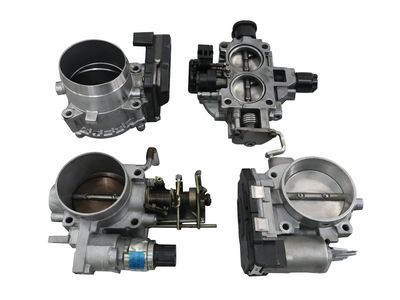
Mazda Tribute Throttle Body Part Number: YF09-13-640B
Mazda Tribute Throttle Body Part Number: YF10-13-640C
Mazda Tribute Throttle Body Part Number: AJC1-13-640
Mazda Tribute Throttle Body
The Mazda Tribute Throttle Body controls the amount of air that moves into the engine to allow the SUV to accelerate smoothly and burn fuel efficiently. It is placed between the air cleaner and intake manifold; it has a butterfly plate that opens as the accelerator operates, when more air is needed, and the sensors start asking the PCM to add fuel to maintain the right air-fuel ratio. The Tribute editions of the early 2000s opted to make it simple with a cable connecting the pedal to the plate, a design that millions of Mazda drivers are accustomed to for its direct feel. Subsequent production years changed to electronic throttle control and substituted the cable with an electric motor that is activated by the PCM, which enhances idle stability and allows traction and stability software to intervene in case of wheel slippage. Both designs have an idle air control passage and a throttle position sensor to enable the computer to maintain fine adjustment in speed when you are coasting or when you are at rest. Older Mazda engines applied to use a single unit Throttle Body injection system, in which one or two injectors are mounted over the throttle blades; however, more recent multi-port units have separated fuel delivery and the housing to tighten response and reduce emissions. Irrespective of generation, the deposits on the Mazda Throttle Body may result in rough idle and stalling, but a thorough cleaning or sensor replacement will normally revive sharp pedal action and reliable airflow management.
Looking for Throttle Body with proven quality? Choose OEM Throttle Body. Mazda designs and builds them to strict factory specs. Every piece goes through rigorous quality checks. You'll get parts that fit right and work like new. Shop our huge inventory of OEM Mazda Tribute parts. Enjoy the highly competitive prices online. Our site is your one-stop shop. Each genuine Tribute part includes a manufacturer's warranty. Buy with confidence. Our return policy is simple and hassle-free. In a rush? Choose expedited delivery at checkout. You'll love the streamlined experience from search to checkout to receiving your order.
Mazda Tribute Throttle Body Parts and Q&A
- Q:How to remove and install the throttle body on Mazda Tribute?A:To take out throttle body, firstly, unconnect the cable to negative battery terminal. In four-cylinder models, remove the Accelerator Cable at the side of the air intake duct in 2008 models and earlier, and in V6 models, disconnect the crankcase vent hose. Then, loosen the screw of the hose clamp and disconnect the air intake duct to throttle body, and, in the case of having a cruise control, the accelerator cable and, if present, the cruise control cable to throttle body. Installation Disconnect the electrical connectors to both Throttle Position sensor and Idle Air Control valve with the IAC harness being detached in V6 models at the throttle body mounting stud. On V6 models, dislocate the bracket of the transaxle vent tube, remove the throttle body mounting bolts and disassemble the throttle body out of the manifold, and throw away the gasket. On 2009 to 2012 models, take out the air filter housing and throttle body outlet duct, electrical connector, and throttle body, lift off throttle body with the removal of the mounting bolts. On 2013 and later 1.5L, 1.6L, 2.0L, raise the front of the vehicle, take off the engine undercover and disconnect throttle body inlet hose. Dislink throttle body electrical connector, undo four bolts and examine the O-ring whether it is damaged or not. In 2013 and subsequent 2.5L engines, the engine cover can be removed, the intake air hose may be disconnected, and this should be repeated to remove throttle body. To install, a new gasket, throttle body, and tighten the mounting bolts are required. Once the battery has been reconnected, it will be necessary to relearn the idle and fuel trim strategy in order to best utilize the Powertrain Control Module on 2012 and prior models. Lastly, switch on the engine to ensure that throttle body is functioning properly and to inspect whether there is any leakage of air.
Related Mazda Tribute Parts
 Mazda Tribute Accelerator Cable
 Mazda Tribute Air Filter
 Mazda Tribute Throttle Cable
 Mazda Tribute Accelerator Pedal
 Mazda Tribute Air Intake Hose
 Mazda Tribute Fuel Filler Hose
 Mazda Tribute Fuel Hose
 Mazda Tribute Fuel Pressure Regulator
 Mazda Tribute Fuel Pump Driver Module
 Mazda Tribute Fuel Tank Strap
 Mazda Tribute Intake Manifold Gasket
 Mazda Tribute Throttle Body Gasket